

Why Walter Isaacson’s Leonardo da Vinci Biography Stands Out
Leonardo da Vinci by Walter Isaacson is a detailed biography that explores the life, mind, and work of the Renaissance genius behind The Last Supper, Mona Lisa, and a lifetime of notebooks filled with sketches, inventions, and studies of the human body. Drawing from thousands of pages of Leonardo’s surviving notes, Isaacson shows how his deep curiosity, sharp observation, and ability to cross between art and science shaped his genius. The book follows Leonardo’s drive to understand everything—from how water flows to how birds fly—and reveals how this constant search for knowledge defined both his art and his science.
About the Author
Walter Isaacson writes about people who change the world. He has written books on Steve Jobs, Albert Einstein, Benjamin Franklin, and Leonardo da Vinci. He studies their lives closely. He looks at what made them great. He writes in a clear voice, with strong facts and simple words. Isaacson was once the editor of Time and the head of CNN. He also taught at Tulane University. He believes that true genius comes from curiosity, hard work, and a deep love of learning. His books help readers see how great minds think.
Leonardo da Vinci Biography by Walter Isaacson Book Review
Walter Isaacson’s Leonardo da Vinci is a clear and direct biography of a man who studied everything. The book follows Leonardo’s life from his birth in Vinci to his death in France. It shows him as a painter, a thinker, a scientist, and an engineer. Isaacson uses Leonardo’s notebooks, sketches, and letters to help readers understand how his mind worked.
Leonardo da Vinci was born in 1452. He was left-handed and wrote in mirror script. He had no formal education in Latin or math. Still, he studied nature, light, and human bodies with great care. He asked questions that few people thought to ask. Isaacson writes about how Leonardo watched birds fly and water flow. He studied muscles and bones. He drew machines that could never be built but still showed great thought.
This Leonardo da Vinci biography does not just talk about art. It also tells how Leonardo worked on military plans, stage sets, and city layouts. He loved learning and wrote down what he saw and thought. Isaacson highlights his deep curiosity. Leonardo did not finish many projects. He worked slowly. He wanted to understand everything before he acted. That often kept him from completing tasks, but it also pushed him to see things in new ways.
The book gives clear accounts of how The Last Supper and Mona Lisa were made. Isaacson shows the science behind the paintings. He explains how Leonardo used light and shadow. He tells how Leonardo studied human expressions and how he painted smiles that looked real. Readers learn how science helped Leonardo become a better artist.
Isaacson also shows the flaws in Leonardo. He spent years on notes and drawings that went nowhere. He left many works unfinished. But Isaacson does not judge him harshly. He shows that Leonardo’s art and science grew from the same source: his desire to learn.
The writing is clean and easy to read. Isaacson avoids hard words. He does not add things that are not needed. Each chapter gives a clear part of Leonardo’s story. The timeline is easy to follow. The book is long, but it moves well. The use of quotes from Leonardo’s notebooks adds life to the pages.
This book is for readers who want to know more about Leonardo da Vinci’s life, his art, and his science. It works well as a general biography. It also helps students, artists, and thinkers understand how curiosity can lead to greatness.
Isaacson’s Leonardo da Vinci is a strong and honest book. It shows the mind of a man who kept learning all his life. If you are looking for a well-written Leonardo da Vinci biography, this is it.neering spirit continue to captivate and inspire. The title encapsulates the individuality of Leonardo, and Isaacson’s meticulous research and eloquent prose make this biography a captivating and enlightening journey through the life and legacy of one of history’s greatest minds.
Walter Isaacson’s Leonardo da Vinci is more than a story—it’s a guide to how curiosity can lead to greatness. Through clear writing and deep research, it shows how Leonardo thought, worked, and saw the world. If you’re drawn to history, art, science, or the life of one of the greatest minds ever, this book is worth your time. Read it now and discover what made Leonardo da Vinci a true genius.
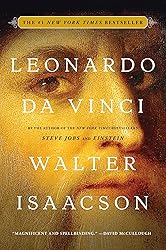
Leonardo da Vinci Biography Book Details

Leonardo da Vinci wanted to know everything. He watched birds fly. He cut into bodies to see how the heart worked. He studied rocks and plants. He drew machines that looked like dreams. He asked questions no one else did. And he wrote it all down.
In this book, Walter Isaacson tells his story. He uses thousands of pages from Leonardo’s notebooks. He writes about how Leonardo’s art and science were the same. Both came from his deep curiosity. He looked hard at the world and tried to understand it. He painted The Last Supper and Mona Lisa. But he also sketched weapons, flying machines, and bones.
Leonardo had no formal schooling, yet he learned more than most. He watched. He thought. He drew. He never stopped. Isaacson shows how Leonardo’s gift came not from magic, but from habits we can learn: to question, to observe, to imagine.
This book is a full portrait of the man. Artist. Scientist. Dreamer. It shows why he still matters. Leonardo da Vinci is a story of genius, drawn in sharp lines and simple words. It reminds us that great minds grow from curiosity, not titles.
My Goodreads Review:
Leonardo da Vinci by Walter Isaacson
My rating: 5 of 5 stars
“Leonardo da Vinci” by Walter Isaacson is a masterfully crafted biography that delves deep into the life and genius of one of history’s most extraordinary individuals. With meticulous research and engaging storytelling, Isaacson unveils da Vinci’s insatiable curiosity, artistic brilliance, and boundless creativity, painting a vivid portrait of a true Renaissance man.
Although I would say that this is generally a boring book, it kept me captivated as I realized that there was more to learn about Leonardo Da Vinci. What I knew about him from history has changed because I learned so many new things about him. I now understand the stories behind the Mona Lisa and The Last Supper paintings.
View all my reviews

